Understanding how AI works
Develop a basic awareness of AI in everyday life
Types of AI
Interact with simple AI tools
Responsible use of AI
Learn fundamental concepts of digital citizenship
Vinschool is pioneering the future of education with the official launch of its Artificial Intelligence (AI) Programme, beginning in the 2025–2026 academic year. Designed for all children aged 5 to 18, the programme is set to equip students with necessary mindset, skills, and ethical understanding to lead proactively and responsibly in the AI era.
The AI curriculum is meticulously crafted, drawing upon global standards such as the EU’s Digital Competence Framework and UNESCO’s AI Competency Framework for students and teachers. With the specialized academic guidance of the College of Engineering & Computer Science at VinUni, the programme ensures both academic rigor and practical relevance. Its content is strategically sequenced across all grade levels to align with the evolving cognitive and psychological development of every student.
Instead of isolating AI as a standalone course, we embed it seamlessly across existing subjects. This interdisciplinary approach ensures students experience AI naturally, gaining a holistic and practical understanding. The program’s core learning standards revolve around three vital competency strands: Understanding AI, Types of AI, and Responsible Use of AI.
These three strands are underpinned by four essential mindsets that Vinschool actively cultivates: computational thinking, systems thinking, design thinking, and critical & creative thinking.

Students conceptual mastery of AI systems, focusing on how data and algorithms emulate human decision-making processes. At the same time, they sharpen their computational thinking skills, such as pattern recognition, structural analysis (decomposition), and algorithmic design.
Furthermore, students learn to apply mathematical concepts – including data analysis, probability, and spatial reasoning to AI, while examining how the quality of training data directly affects the overall performance of AI systems.
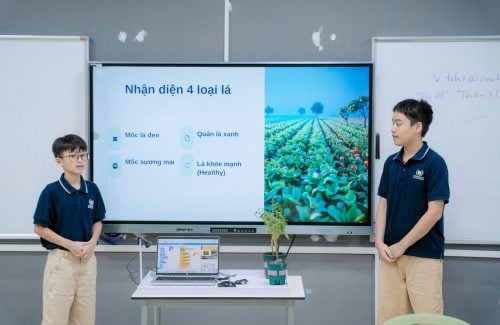
Students deepen their understanding by engaging with a wide spectrum of AI applications. They learn to identify various AI tools, from automated processes to cutting-edge generative platforms, and analyze their core functions. This hands-on experience allows them to grasp how algorithms process massive datasets to power these technologies. In addition, they critically evaluate the role of AI within digital systems and assess its real-world impact.
.
Students develop an understanding of the ethical implications of AI by examining issues such as misinformation, algorithmic bias, and social media manipulation. They also evaluate data collection and machine learning processes. Concurrently, they explore broader social concerns including job displacement, sustainability, and the necessity of building inclusive AI systems that actively mitigate bias and ensure cultural appropriateness.
Develop a basic awareness of AI in everyday life
Interact with simple AI tools
Learn fundamental concepts of digital citizenship
Explore algorithms and data.
Engage with basic recommendation systems and chatbots.
Learn about data privacy and protection.
Analyze the functions of AI systems
Explore image recognition and natural language processing
Examine algorithmic bias and fairness
Build a strong foundation in data processing and AI algorithms to analyze and interact with AI systems more deeply.
Understand AI hardware and systems; use AI responsibly for research, content creation, problem-solving, and collaboration.
Reflect on AI use through feedback, manage digital footprints, and understand data protection laws. Students identify ethical challenges, assess AI reliability and social impact, and design AI-driven solutions based on clear criteria and community engagement.
Develop in-depth data analysis and algorithm implementation skills, prepare to design, evaluate and apply AI solutions responsibly while considering social, environmental and global impacts, combining technical knowledge with critical thinking to become informed designers and users of AI.
Analyze AI hardware and emerging technologies, apply advanced command design techniques, manage complex projects, and develop in-depth evaluation skills to review AI systems, draw evidence-based conclusions, and adapt solutions as conditions change.
Enhance critical thinking by considering other perspectives, assessing long-term risks, privacy, security, and ethical situations, analyzing the trade-off between humans and AI, applying international law, managing mental health impacts, and demonstrating responsibility as users and designers of AI.
AI competencies empower students to build a profound and integrated knowledge by teaching them to critically analyze, verify, and apply information from digital sources. As students learn to evaluate AI-generated content and data patterns, they achieve deeper subject mastery across diverse disciplines.
The ethical use of AI tools for research and problem-solving significantly amplifies their ability to synthesize complex ideas. This transforms them into highly discerning learners who effortlessly navigate the digital information landscape while excelling in academic content. Ultimately, AI literacy is key to strengthening both subject-specific knowledge and transferable research capabilities for lifelong learning.
Students progress toward full autonomy in leveraging technology and AI systems. They learn to interact with, evaluate, and utilize AI tools with
minimal oversight, fostering unwavering confidence in digital environments. Learners can independently analyze AI-generated content across different formats and subject areas, assessing its reliability and potential biases. They become proficient at formulating effective queries for AI systems, critically interpreting responses, and iteratively refining their approaches based on the output.
Students naturally integrate their AI knowledge into problem-solving, formulating relevant follow-up questions and verifying information across multiple sources. They develop the ability to proactively manage technical challenges, adapt quickly to new AI applications, and make informed decisions on when and how to deploy these tools. As self-directed learners, they strategically leverage AI resources alongside traditional references, peer support, and mentors to enhance their understanding and expand their capabilities. This technological autonomy emerges progressively as students master core AI competencies across grade levels.
With AI competencies, students learn to flexibly adapt their technology use to suit specific users, purposes, and academic requirements, whether crafting evidence-based arguments, analyzing complex data trends, or designing innovative solutions. They develop the discretion to select appropriate AI tools and adjust their queries based on context, ranging from formal research projects to collaborative problem-solving tasks. By evaluating AI outputs through multiple perspectives (scientific, ethical, creative), they gain maximum agility in applying digital tools to meet diverse academic and
real-world challenges. This allows students to seamlessly pivot between technical precision and efficient application.
Students skillfully employ AI tools to deepen learning across all disciplines while maintaining critical awareness of each tool’s appropriate applications. These learners master the strategic selection and combination of digital resources, knowing precisely when to use generative AI for brainstorming, data analysis tools for research, or algorithmic systems for problem-solving while consciously integrating these technologies with traditional learning methods to maximize both efficiency and quality.
An AI-competent student approaches technology with both understanding and critical discernment. They engage thoughtfully with AI systems, exploring their capabilities with curiosity while rigorously examining outputs for accuracy, bias, and logical consistency. These learners develop the ability to interpret AI-generated content, trace its underlying reasoning processes, and identify potential limitations in the training data or algorithmic design. They cultivate a balanced perspective that values AI’s immense potential while maintaining healthy professional skepticism, always cross-verifying important information and considering all relevant ethical factors.
AI-competent students recognize that modern learning and work environments bring together diverse global perspectives and leverage technology to successfully collaborate within such environments. They utilize AI tools to explore cultural contexts far beyond their immediate experience, from analyzing international datasets to engaging with multilingual AI systems to strengthen their language proficiency.
Most importantly, they maintain acute cultural awareness, actively seeking to identify cultural biases that may emerge in training data and outputs, thereby fulfilling their ethical responsibilities.
These qualities and competencies lay the foundation for a generation of students who can be proactive, creative, and ethical in their learning and careers, making invaluable contributions to the broader AI-driven society.