
Looking back at Math Nexus: Assessing mathematical thinking, not just the final answer
In many mathematics competitions, students' performance is judged primarily by whether they arrive at the correct answer. Math Nexus, however, takes a different approach. Rather than evaluating only the final solution, the competition also assesses the thinking process that leads students there.
This distinction is not about lowering expectations for accuracy. On the contrary, it reflects a more complete understanding of what it means to learn mathematics. In mathematics, a strong solution is not simply correct – it is supported by clear reasoning, an appropriate strategy, and the ability to monitor, evaluate, and refine one’s thinking when challenges arise.
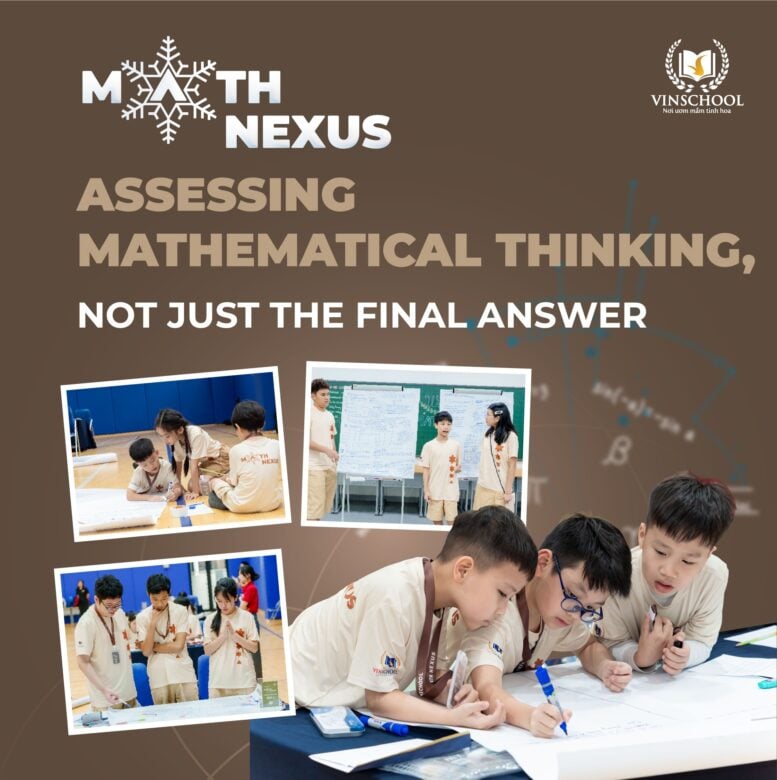
Throughout the competition, students are required to preserve their entire problem-solving process, including incomplete attempts and discarded ideas. As a result, each submission reveals not only what answer a student reached, but how they approached the problem, tested hypotheses, revised their reasoning, and responded to mistakes or changing conditions. This aligns closely with Vinschool’s approach to mathematics education, where the essence of mathematical proficiency lies in analysing problems, developing strategies, justifying reasoning, and adapting one’s approach when necessary.
In this sense, Math Nexus is more than simply an unconventional mathematics competition. More importantly, its assessment model reflects what contemporary mathematics education increasingly values. Research in the learning sciences suggests that students develop deeper understanding when they are expected not only to produce answers, but also to explain their thinking, recognise weaknesses in their reasoning, and revise their approaches independently. In other words, meaningful learning is not merely about knowing the answer; it is about understanding one’s own thinking – a capacity known as metacognition.
This has become even more significant in an era when technology and artificial intelligence can increasingly perform calculations and generate standard solutions. The value of human learners no longer lies primarily in speed, but in their ability to interpret unfamiliar problems, evaluate the soundness of solutions, and identify effective approaches when faced with new challenges.
Viewed from this perspective, Math Nexus also reflects Vinschool’s broader philosophy of mathematics education. While maintaining high expectations for conceptual understanding, procedural fluency, and mathematical accuracy, the programme places equal emphasis on the enduring competencies that matter most for future learning: logical reasoning, critical thinking, mathematical modelling, experimentation, and reflective practice. This is not innovation for its own sake, but a deliberate effort to align mathematics education more closely with the true nature of mathematical thinking.
Ultimately, a mathematically capable student is not simply someone who works quickly or consistently arrives at the correct answer. More importantly, it is someone who understands what they are doing, why a particular strategy works, and how to adapt their thinking when confronted with new problems. Seen through this lens, Math Nexus is more than a competition – it represents Vinschool’s vision for how mathematics should be taught, learned, and assessed.