Talents Taking Flight on the GATE “Runway”: How Personalized Pathways Make the Difference
One student once struggled between technology and the arts before eventually finding her path in Computer Science. A teenage drummer committed to years of intensive training to reach international performance standards. One student brought history beyond textbooks, transforming it into a space for academic dialogue within the community. A rescue drone project grew from a genuine concern about natural disasters and the real-world application of technology.
At first glance, these journeys seem to have little in common: different fields, different learning approaches, different destinations. Yet beneath those differences lies a shared foundation: each student was nurtured through a personalized pathway designed specifically for them at the GATE Center for Counseling and Talent Development at Vinschool.
At the GATE Center, personalization goes beyond creating different learning experiences for each student. It is a process of building an Advanced Learning Plan (ALP) tailored to every student’s abilities, intrinsic motivation, development direction, and long-term goals. More importantly, an ALP is not a fixed roadmap, but a continuously evolving plan that adapts to each student’s actual growth over time.
According to representatives from the GATE Center, many students experience significant shifts in direction or surpass their initial goals after undergoing intensive training in the early stages. This is why GATE adopts an open-ended approach. Rather than placing students into rigid developmental frameworks, the Center creates enough space for them to explore, experiment, and gradually discover the path that suits them best.
Nguyễn Ngọc Thủy Linh: When “Not Knowing Who You Are Yet” Is No Longer a Disadvantage
During her early years at the GATE Center, Thủy Linh demonstrated interests across a wide range of fields — from Social Sciences to Technology, from environmental issues to storytelling and content creation. What connected all the projects she pursued was her desire to create positive value for the community.
With such a diverse profile, instead of directing her immediately toward a specific major, Linh’s ALP was designed with an interdisciplinary approach, allowing her to develop multiple competencies simultaneously through real-world projects.
In the beginning, Linh explored environmental research while also participating in courses on scriptwriting, filming, editing, and film production under the guidance of industry experts. The result was The Voice Outside Our Glasses, a short film that won the Gold Award at Bow Seat 2021 — an international competition focused on art and environmental awareness.
However, the most notable aspect was not the award itself, but what came afterward.
As Linh’s multidisciplinary potential and expanding interests became increasingly evident, the GATE Center adjusted her ALP toward developing Silexa — a role-playing game project initiated by Linh herself to help learners approach coding through interactive experiences.
When she first started the project, Linh had almost no programming background. Instead of requiring students to be “good enough before starting,” GATE designed a step-by-step pathway: learning foundational coding, working alongside mentors, and gradually developing game design skills.
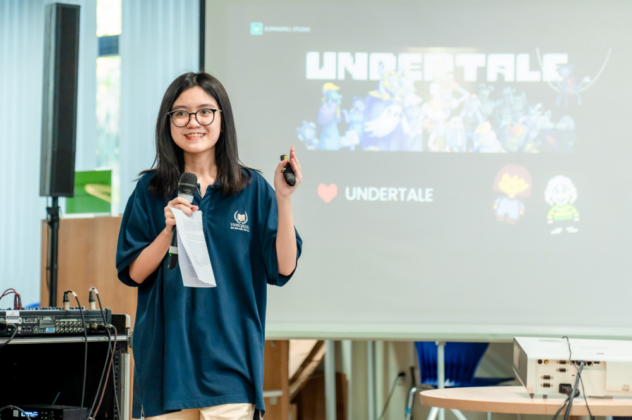
After more than three years, the project launched its demo through an experiential workshop for students.
“Thủy Linh’s journey is a typical example of the personalized direction within GATE’s training programs, where ALPs are never fixed and are not always tied to a predetermined goal,” a representative from the GATE Center shared. “Sometimes, what matters more is creating academic experiences deep enough for talented students to truly discover their own potential.”
This multidimensional journey ultimately helped Linh clearly define her passion for Computer Science and equipped her with the foundation to earn a 70% scholarship in Computer Science at Texas Christian University.
An Nam Anh: When Personalization Is Not About Broadening, but Going Deep Enough
If Thủy Linh represents a journey of multidisciplinary exploration, then An Nam Anh embodies a completely different path.
From the moment he joined the GATE Center, Nam Anh already had a very clear direction: music — specifically drumming.
In this case, the ALP was not designed to broaden experiences horizontally, but instead focused on developing specialized depth over a long period of time.
For six years, Nam Anh trained through a one-on-one pathway with experts, continuously raising standards in core competencies: performance techniques, solo ability, band coordination, and stage production thinking. Notably, the pathway did not operate as a typical “advanced extracurricular program,” but was continuously adjusted according to each stage of the student’s growth, artistic maturity, and evolving direction.
At certain stages, the ALP focused primarily on strengthening and refining technical foundations. Later, the emphasis shifted toward stage performance and collaboration with professional bands, among other aspects. These adjustments were regularly discussed with Nam Anh and his mentors to ensure alignment with the expected outcomes of each developmental stage. Thanks to this long-term and systematic training process, Nam Anh gained opportunities to participate in advanced overseas courses, collaborate with international artists, and perform on professional stages.
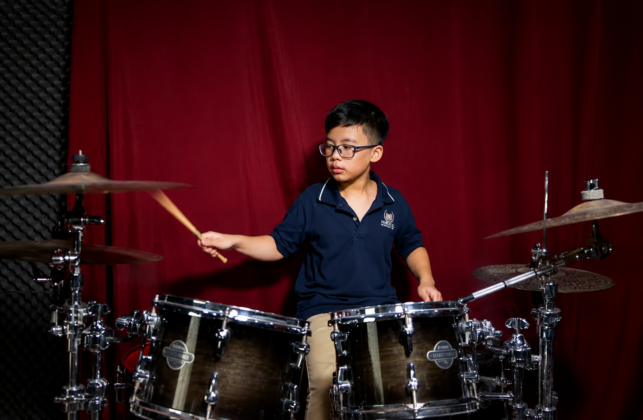
At the age of 15, Nam Anh achieved Trinity Grade 8 — one of the highest levels in the Trinity College London system — with outstanding scores, while also making his mark at international platforms such as the Asia-Pacific Arts Festival and Drum-off Global in Singapore.
However, according to the GATE team, achievements alone are not the ultimate value of this journey.
“The greatest challenge for students pursuing the arts is not only skill, but the ability to sustain discipline and motivation throughout a very long process,” a representative from the Center explained. “Personalization here lies in building a pathway deep enough for students to commit to their chosen field for the long run.”
Nguyễn Kỳ Minh: When Academic Knowledge Connects with Social Life
For Nguyễn Kỳ Minh, history was never merely a school subject, but a field of interest tied to a deep curiosity about politics, culture, and social movements. What he needed, therefore, was not simply knowledge accumulation, but an environment with both academic depth and enough space to share knowledge with others.
In Grade 8, Minh and his collaborators initiated the History Book Stall project — a space for students passionate about history, featuring book reviews, workshops, and discussions on heritage, war memories, and contemporary social issues at Vinschool Central Park and Golden River.
That is also why Minh’s ALP extended beyond advanced academics to include community project-building skills.
“What stands out about Kỳ Minh is not only his academic ability, but also his persistence in pursuing his passion and his desire to spread the value of knowledge to the community,” Minh’s mentor at the GATE Center shared. “GATE’s role is to accompany, guide, and create opportunities for students to gradually realize those goals in ways aligned with their abilities and personal direction.”
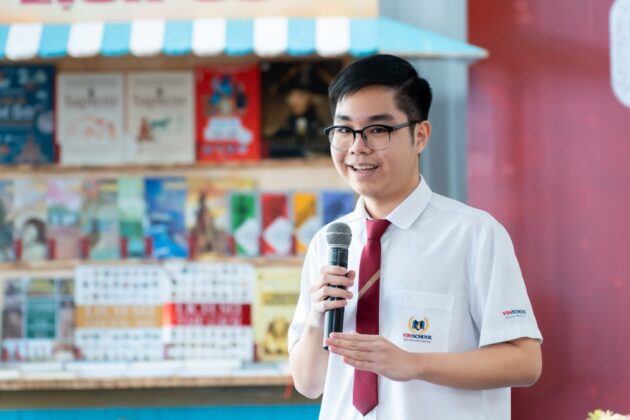
Minh’s journey at the GATE Center concluded with a 100% scholarship to Fulbright University Vietnam and a 50% scholarship in Global Studies at National University of Singapore. Yet for Minh, perhaps the greater value lies in how history transformed from knowledge to memorize into a tool for engaging in social dialogue and building community connections.
Bùi Khánh Minh: Building the Foundation for an Aviation Dream
Bùi Khánh Minh joined GATE in Grade 8 with a special passion for aviation and rocket engineering. Recognizing Minh’s potential and enthusiasm, GATE gradually created opportunities for him to participate in real-world projects and pursue his passion in a more structured and specialized way.
This is a field that demands a high level of academic and technical foundation, as well as the ability to self-study, research, and experiment continuously over many years.
Therefore, instead of focusing on short-term training programs or projects, Minh’s ALP was designed to build sustainable foundations in aerodynamics, control systems, UAV design, and applied research thinking.
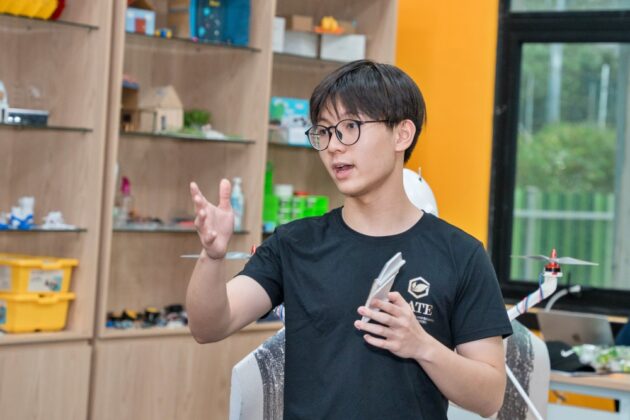
One of Minh’s notable projects was The Servator — a drone designed to support disaster victim search and rescue, integrating GPS, cameras, and machine learning technology. The challenge was not only in developing the project idea, but in transforming that idea into a product validated through real technical capability.
“Many students have ambitious ideas,” Minh’s mentor shared. “But turning an idea into a functioning product requires going through countless cycles of testing, failure, and adjustment. That is the most important part of developing capability.”
The project later received intellectual property protection and won awards at international competitions such as StarT Competition and Pratt & Whitney Singapore Invention Convention. Minh is currently studying at Purdue University — one of the world’s leading institutions in aerospace engineering.
There Is No Universal Formula for Talent Development
According to the GATE Center, the core of personalization does not lie in creating “special” pathways, but in recognizing students as individuals with different developmental speeds, motivations, and learning styles.
Instead of applying a single standardized model, the GATE Center designs ALPs as open systems: with clear goals and professional standards, yet flexible enough to adapt to each student’s real development over time.
ALPs are reviewed regularly with students and parents, and may evolve in terms of goals, training intensity, mentors, or experiential opportunities depending on each stage of development.
Within this approach, awards and scholarships are not viewed as final destinations, but as part of the process of validating students’ capabilities.
What the GATE Center ultimately strives for is to help students deeply develop their talents in the fields they pursue, while creating opportunities for them to generate value through their own unique strengths.
Perhaps that is why, despite following vastly different trajectories, Vinschool’s talented students still share one thing in common: they are not trained to become “better versions of the same model,” but are developed to become the version of themselves that fits them best.
![[HN & TP.HCM] GATE CENTER OFFICIALLY LAUNCHES THE TALENTED STUDENTS SELECTION PROGRAM – FUTURE INNOVATORS 2026](https://vinschool.edu.vn/wp-content/uploads/2026/01/07/Anh-bia-06-500x325.jpg)