High school students conducting research like university undergraduates: The distinctive advantage of Cambridge IPQ at Vinschool
“The economic - social - technological factors shaping the competitiveness of Vietnam’s music industry”, “The role of state-owned enterprises in economic growth”, and “The relationship between tea leaf fermentation and anti-inflammatory properties in neuroprotective mechanisms” — these are not university research projects, but studies conducted by Vinschool students as part of the Cambridge International Project Qualification (Cambridge IPQ).
Through Cambridge IPQ, students gain early exposure to independent academic research — from formulating research questions and evaluating academic literature to selecting appropriate methodologies, analyzing data, and presenting findings according to international academic standards.
At Vinschool, Cambridge IPQ is offered to Cambridge students from Grade 11 as an independent research program within the Cambridge Advanced pathway, alongside Cambridge International AS & A Level program. It provides students with an opportunity to develop research skills, academic writing abilities, and independent learning competencies — all of which are essential foundations for success in international higher education.
INTRODUCING ACADEMIC RESEARCH AT THE HIGH SCHOOL LEVEL
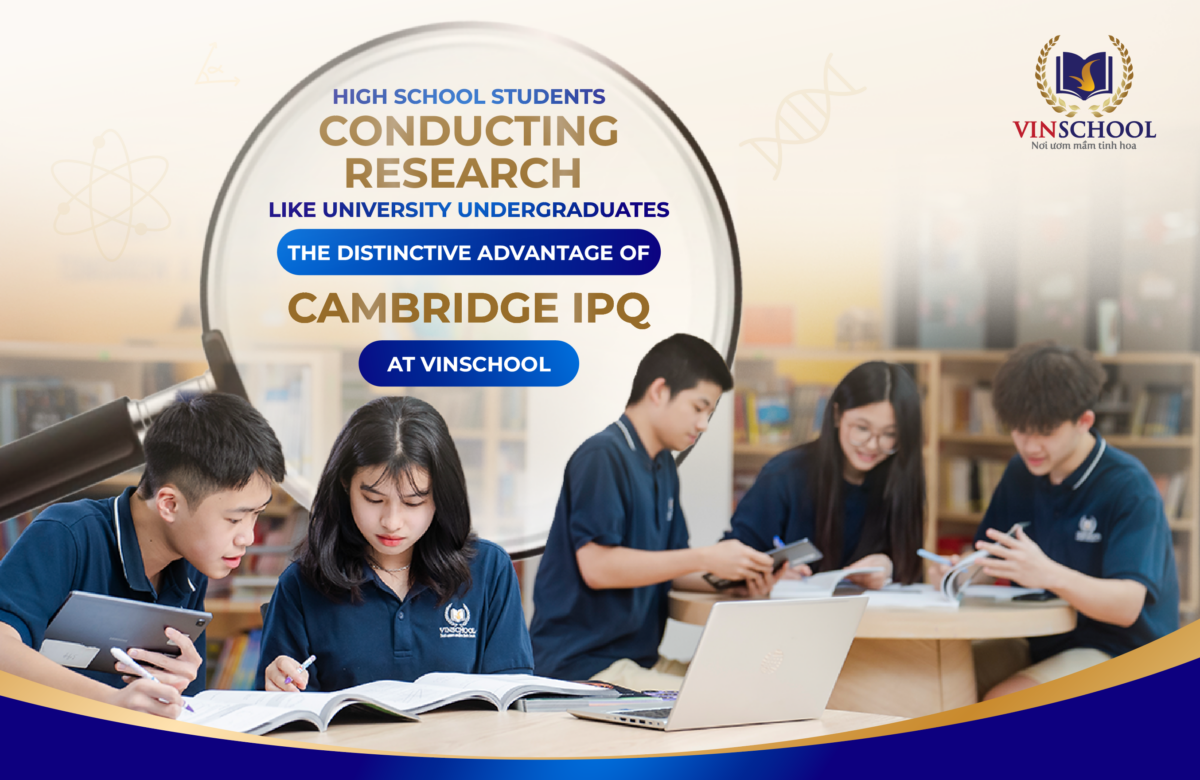
In Cambridge IPQ, students independently conduct a research project on a topic of personal interest under the guidance of a subject specialist teacher. Research topics may span a wide range of disciplines, including science, economics, psychology, education, and contemporary social issues, enabling students to explore the world through their own perspectives while developing interdisciplinary thinking.
Throughout the program, students formulate research questions, locate and evaluate academic sources, select suitable research methodologies, analyze data, and present their findings in a research paper of approximately 5,000 words that meets international academic standards.
Alongside the research paper, students maintain a research log to document the development of their ideas, adjustments to hypotheses, project management processes, and reflections on their learning journey. This is a key component of IPQ, designed to foster a continuous and systematic research mindset rather than focusing solely on the final outcome.
DEVELOPING RESEARCH AND CRITICAL THINKING SKILLS
Throughout the research process, students cultivate the core competencies of academic inquiry.
– Formulating research questions: Students learn how to define a research scope, assess feasibility based on available data, and develop clear, specific, and testable research questions.
– Selecting research methodologies: Depending on the subject area, students may conduct laboratory experiments, surveys, interviews, or secondary data analysis. Through this process, they gain an understanding of the strengths, reliability, and limitations of different research methods while learning how to interpret data accurately and critically.
– Evaluating sources and academic referencing: Students are guided in identifying credible sources, utilizing academic literature, and adhering to international citation standards to ensure transparency and academic integrity.
– Ethical use of AI in data analysis and systematic data exploration: Students learn how to use AI tools as support mechanisms for data discovery, organization, and analysis while maintaining academic transparency and ensuring that independent thinking remains at the center of the research process.
Through these experiences, students gradually develop critical thinking skills and the ability to evaluate evidence independently.
Ngo Gia Minh Hanh (a Grade 11 Vinser), author of the research project “Should the government impose stricter regulations on the private sector to combat corporate corruption In Vietnam?”, shared that one of the most challenging yet rewarding aspects of the process was comparing sources with differing conclusions and independently assessing the reliability of various types of evidence.
“I realized that research is not about finding information to support an existing viewpoint. It is about continuously asking questions, testing assumptions, and being willing to revise your perspective when the evidence points to a more convincing explanation”, Hanh reflected.
Similarly, while investigating the question “To what extent does public awareness of traffic laws influence compliance with traffic regulations in Hanoi?” – Grade 11 Vinser Bui Pham Minh Chau found that conducting surveys and analyzing data fundamentally changed the way she approached complex issues.
“At first, I believed that a lack of knowledge about traffic laws was the main reason people failed to comply with regulations. However, through the research process, I discovered that many other factors were equally influential. This experience taught me to examine issues more deeply rather than relying solely on my initial assumptions,” Chau explained.
A PERSONALIZED MENTORSHIP MODEL
One of the distinctive strengths of Cambridge IPQ at Vinschool is the personalized academic mentoring model.
Each student is paired with a mentor whose expertise closely aligns with the student’s research area, typically an experienced A Level teacher with a strong academic background. Through regular consultations, students receive in-depth feedback on their research questions, methodologies, data analysis, and academic arguments — a process comparable to the supervision model commonly found at international universities.
This guidance enables students to maintain academic independence while ensuring that their research remains focused, feasible, and intellectually rigorous.
“Mr. Reza, my mentor and Global Perspectives teacher, did more than tell me what to do. He helped me understand the reasoning behind every research decision. Whenever I refined my research question, he guided me in narrowing the scope, evaluating variables, and verifying the data required. I also learned how to approach sources critically, especially by cross-checking information across multiple sources,” Minh Hanh shared.
She added that one of the most valuable lessons from IPQ was learning how to identify gaps in existing data and research methodologies in order to explain why her study was necessary, rather than simply summarizing previous research.
A STRONG ACADEMIC ADVANTAGE FOR INTERNATIONAL HIGHER EDUCATION
The greatest value of Cambridge IPQ lies not in the qualification itself, but in how it transforms students’ approach to learning and knowledge acquisition.
After completing the research process, students move beyond memorization and passive learning. Instead, they learn to ask questions, evaluate information critically, and construct evidence-based arguments and perspectives.
At the same time, they develop a range of competencies essential for university study, including independent research, academic writing, long-term project management, data analysis, and systematic argumentation.
This is also why Cambridge IPQ is highly valued by many universities across the United Kingdom, Europe, and the United States. In many cases, an IPQ project becomes a standout feature in a student’s personal statement or university admissions interview.
More importantly, students who have completed IPQ often enjoy a significant advantage when transitioning to university, as they are already familiar with the academic expectations and learning approaches required in higher education.
Cambridge IPQ at Vinschool is therefore more than an independent research program. It represents a transformative step from being a high school student to becoming an independent learner — empowering students to engage in research, construct knowledge, and develop academic thinking while still in high school.