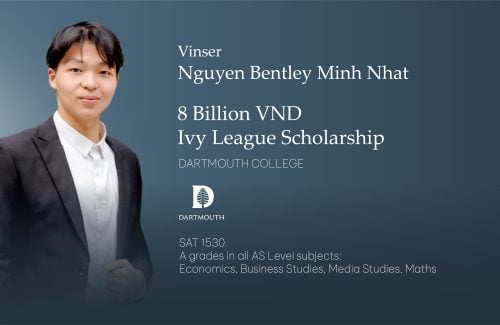
The three students below represent three very different journeys. Yet they share one thing in common: each earned admission to a world-leading university in a way that was uniquely their own.
Nguyen Duc Minh – A Builder’s Mindset Leading to Carnegie Mellon University, Top 3 Worldwide for Computer Science
“I’ve always wanted to create technological products that genuinely solve real-world problems.” Guided by this philosophy, Nguyen Duc Minh, a Grade 12 student from Vinschool The Harmony, earned admission to Carnegie Mellon University (CMU) — ranked among the world’s Top 3 universities for Computer Science — through a combination of sharp builder thinking, strong academic foundations, and highly applicable projects at the intersection of AI and cognitive psychology that create meaningful impact for the community.
Minh’s passion for Computer Science was systematically nurtured at Vinschool through the GATE Center (Gifted and Talented Education Center), where he had opportunities to deepen his strengths, experiment with ideas, and transform knowledge into real-world products through a personalized program and close mentorship from leading STEM experts. From this environment, Minh and his teammates won First Prize at the 31st National Youth Informatics Competition with their AI project “Ignition” — a platform designed to support creative ideation and optimize workflows.
At the same time, Vinschool’s AP and Cambridge programs helped Minh build an outstanding academic profile, including a perfect 5/5 score in AP Calculus BC, an A* in A-Level Mathematics (early examination), straight As across all AS-Level subjects, an IELTS score of 8.5, and a 35/36 ACT score. These achievements reflect not only academic excellence, but also strong logical thinking, self-directed learning, and discipline.
“The most important thing I learned at Vinschool was how to deeply understand concepts instead of memorizing mechanically. The environment gave me the opportunity to discover my potential while encouraging me to proactively explore and develop holistically,” Minh shared.
What distinguished Minh’s application was not simply technical achievements, but the consistency of his personal narrative: a builder’s mindset — the ability to use technology to solve real-world problems. In his application essay, rather than focusing on awards, Minh centered on the development journey of Ignition — from identifying problems and experimenting with solutions to learning through trial and error and continuously improving based on user feedback. This approach reflected the mindset of a product developer: someone who can identify problems, build solutions, and create meaningful value.
For Minh, technology is not the destination, but a tool to create impact. His university journey ahead will continue to be one of expanding knowledge, building connections, and turning meaningful ideas into reality for the community.
Ngo Tri Dung – When Exploration Becomes the “Key” to Discovering Passion and Earning a Place at Duke University, Top 6 in the U.S. for Biomedical Engineering
The journey of Ngo Tri Dung, a Grade 12 student from Vinschool The Harmony, did not follow a straight path. Instead, it was shaped through intentional exploration to find the direction that suited him best. That process ultimately led him to Duke University with a major in Biomedical Engineering.
Dung first developed an interest in technology and computers in Grade 9, then considered becoming a doctor in Grade 10 due to his growing fascination with medicine. Over time, however, he realized that his strengths lay not in pursuing pure medicine, but in mathematical and engineering thinking. That was when a “third direction” became clearer.
Rather than choosing between technology or medicine, Dung decided to pursue Biomedical Engineering — a field where engineering is directly applied to healthcare challenges, from MRI diagnostic devices and genetic technologies to manufacturing and operations in the biomedical industry. Early exposure to AP subjects at Vinschool, including Biology, Calculus BC, and Computer Science — all subjects in which he achieved perfect 5/5 scores — also helped him become familiar with university-level academic thinking and explore his interests more deeply. Through this process, he recognized the intersection between technology and medicine and established his academic direction.
If academic foundations gave depth to his thinking, research and internship experiences helped Dung test that direction in practice. From participating in research on biomaterials for wound healing to proactively seeking internship opportunities in biotech companies, Dung gradually developed a clearer understanding of how knowledge translates into real-world applications.
A project on collagen extracted from fish scales introduced him to biomaterials from a medical perspective, where a solution could directly impact wound-healing processes. Another project involving mycelium-based materials for automotive interiors helped him see how biology can move beyond laboratories into manufacturing. Most notably, during a short-term internship at a genetic technology company, he observed for the first time how ideas are tested in real-world environments — where solutions must not only be scientifically sound, but also feasible and valuable.
These experiences enriched not only his application profile, but also his understanding of engineering’s role in solving biomedical challenges.
“In my application, I didn’t try to fit myself into a predefined model. Instead, I let my experiences guide the way,” Dung shared.
His personal essay did not revolve around disconnected activities, but around fundamental questions about human differences and the role of technology in improving quality of life. Biomedical Engineering therefore emerged as a logical connection, rather than an isolated decision.
Dung’s profile ultimately reflected the mindset of an explorer — someone who begins with questions, learns through experiences, and searches for the most meaningful solutions.
For Dung, the right choice is not necessarily the earliest one, but the one formed through truly understanding oneself.
Vu Huyen Thu – From Reflections on Social Equity to the Doors of King’s College London, a Top 6 University in the UK
A question about inequalities in educational opportunities among students from different socioeconomic backgrounds became the starting point of Vu Huyen Thu’s academic journey. From there, the Grade 12 student from Vinschool Central Park earned admission to King’s College London with a major in Economics.
At Vinschool, Thu was exposed early to academically rigorous subjects such as Global Perspectives and Cambridge Economics/Business courses. These experiences helped her understand global economic contexts and recognize how factors such as policy, resource allocation, and economic growth directly shape social issues. Through this lens, she came to see Economics not simply as a field of numbers, but as a tool to understand how societies function and how inequality can be approached from a systemic perspective.
A key academic highlight in Thu’s profile was receiving a “Very High Commendation” in the John Locke Essay Competition, where she analyzed educational inequality from multiple economic perspectives. She also conducted research with a lecturer from the University of Leeds on the role of educational investment in sustainable development.
At the same time, “The Olive Tree” — a community project she founded and sustained for three years to support children affected by Agent Orange and orphans — demonstrated her ability to connect academic thinking with real-world action.
What distinguished Thu’s profile was a clear “red thread”: Economics connected to social equity. From her John Locke essay and academic research to her community initiatives, every experience revolved around one central question — how economic systems can create fairer opportunities.
This reflected the mindset of a systems thinker: someone who not only analyzes problems, but also understands the connections between policy, resources, and social impact.
For Thu, studying Economics is not only about understanding the world, but about contributing to making it better.
A Shared Foundation at Vinschool
Three students, three distinct directions — from Computer Science and Biomedical Engineering to Economics — yet all began from the same foundation at Vinschool: early academic exposure, encouragement to explore, and the freedom to pursue questions of their own.
That environment empowers each student to transform learning experiences into a meaningful personal narrative, build a pathway aligned with their strengths and aspirations, and confidently pursue ambitious goals in their own unique way.
![[ALUMNI CORNER] Võ Nam Khánh: The journey to conquer the world from the “City Of The Future” – Dubai](https://vinschool.edu.vn/wp-content/uploads/2025/01/16/Alumni-08-500x325.png)