[Wellbeing Initiatives 2025–2026] Vinsers Address Learning Challenges Through A Wide Range Of Cognitive Wellbeing Initiatives
In Season 2 of Wellbeing Initiatives, student-led (“made by Vinsers”) cognitive wellbeing projects have introduced a wide range of creative ideas that directly address common learning challenges such as lack of focus, distractions, academic pressure, difficulty retaining knowledge, and ineffective study methods. Instead of seeing these as barriers, Vinsers approach them as problems to be solved with innovative thinking.
From this mindset, Vinsers have developed practical solutions to enhance cognitive wellbeing, including creating “focus zones,” gamifying learning journeys, and building peer learning networks, among others. These initiatives not only help students manage their time and resources more effectively, but also make the journey of learning more engaging and self-driven.
By collaboratively developing and implementing these ideas while forming positive habits, Vinsers are building a connected learning community—where challenges are no longer obstacles, but stepping stones toward growth.
Click on each image to explore how these initiatives are transforming learning into an inspiring cognitive journey!
—
In the 2024–2025 academic year, Vinschool first launched the School Mental Health Wellbeing Initiatives program under the theme “Wellbeing for Better Learning.” The program not only raises awareness but also encourages concrete actions to support mental wellbeing in schools.
In its first season alone, more than 5,500 initiatives were registered, 2,622 were implemented in practice, and nearly 21,000 students, teachers, and parents participated, helping spread the value of mental wellbeing across the entire Vinschool system.
With the Wellbeing Initiatives program, Vinschool was honored in the “Nurturing Wellbeing & Purpose” category at the QS Reimagine Education Awards 2025—a prestigious international award often referred to as the “Oscars of global education,” founded by QS Quacquarelli Symonds, one of the world’s leading higher education ranking organizations.
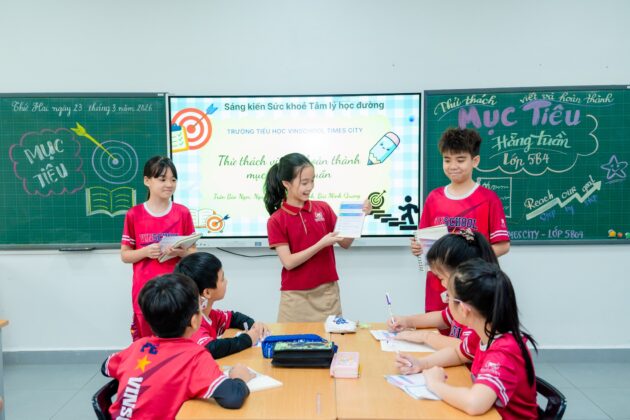
Tasks that are often “left for tomorrow” can gradually pile up, causing many students to lose control over their study routines and daily life. That’s how the “Weekly Goal-Setting & Completion Challenge” was created—starting from a very small action: writing things down.
Each week, students set their goals, prioritize tasks, and reflect on their progress at the end of the week, with recognition and support from teachers. From this simple habit, they gradually improve their time management, reduce missed tasks, and build a stronger sense of responsibility for themselves.
The Vinsers team—Nguyễn Trần Ngọc Minh, Trần Bảo Ngọc, and Bùi Minh Quang—shared:
“Through this challenge, studying has become much less overwhelming for us. Writing down our goals and prioritizing them helps ensure we don’t miss important tasks while still accomplishing what we set out to do. Especially, our parents have been very supportive and have joined us on this journey every week.”
When faced with a choice between what is “easy” and what is “right,” students don’t always find it easy to decide. Inspired by familiar situations in both learning and peer relationships, this initiative was designed to help students better understand the consequences behind every decision.
Through role-playing activities, group discussions, and the “Cause – Consequence – Emotion” mapping framework, students explore different ways to respond to situations, connecting their actions with the emotions and outcomes that follow. This process also creates space for self-reflection on their own choices.
As a result, students gradually develop the habit of thinking before acting, reducing impulsive reactions and making more responsible decisions in both their studies and relationships.
Vinser Nguyễn Nhật Châu Anh shared:
“I believe our initiative is very meaningful because it helps students stay calm and make more responsible decisions. When facing situations like being teased, students have learned to pause, reflect, and choose more positive ways to respond—such as having a calm conversation to resolve conflicts instead of reacting harshly.”
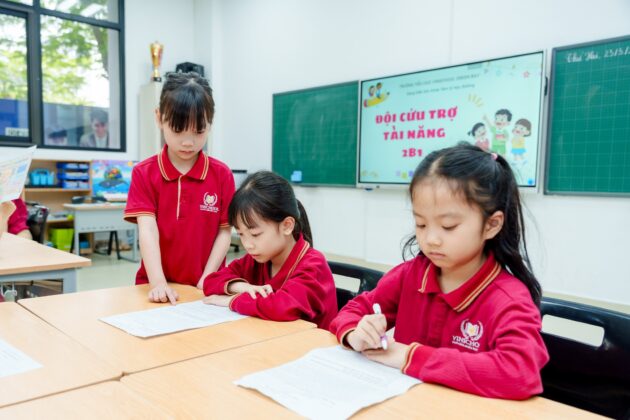
Noticing that some classmates were facing difficulties in reading, writing, or math, students proactively formed the “Talent Rescue Team” as a way to support one another through peer learning.
During lessons and even break time, team members observe and identify their peers’ challenges, then provide support through one-on-one or small group sessions—ranging from reading practice and guided questioning to helping others develop thinking and problem-solving skills.
As a result, students who need support receive timely help and show clear improvement, while team members themselves strengthen their thinking skills, self-learning abilities, and sense of responsibility. More importantly, the classroom becomes more connected, with every student ready to support and learn from one another.
“When I get help from the ‘Rescue Team’ with difficult exercises, I feel more confident because I can complete my work and see myself improving every day,” Vinser Nguyễn Hoài An shared excitedly.
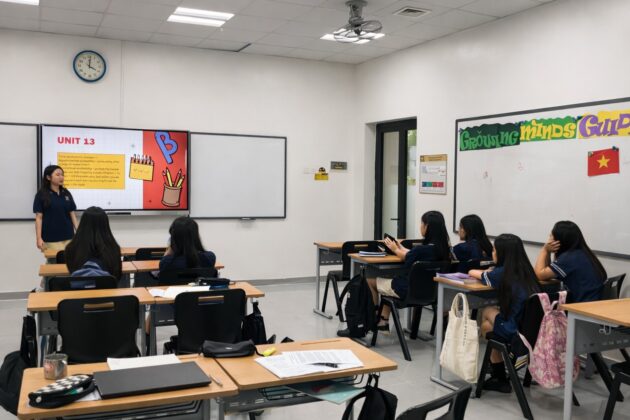
Not every student easily finds a subject they are truly passionate about—especially when the academic workload intensifies toward the end of the school year. From this concern, the “Passion for Learning Club” was initiated by students as a way to transform learning into a journey of discovery.
The club operates under a student-led model, where members collaborate to design content and organize regular sessions based on different subject groups. In each session, students take the lead in creating and facilitating activities such as games, experiments, hands-on exercises, or sharing study tips—while also supporting one another throughout the learning process. As a result, learning is no longer a pressure, but becomes an active and engaging experience—where students gain deeper understanding, build confidence to explore different fields, and gradually discover the subjects they truly love.
Vinser Nguyễn Hoàng Mỹ An shared:
“I feel that the ‘Passion for Learning Club’ has created a very special space where learning becomes more enjoyable and less stressful. Seeing my peers rediscover their interest in different subjects makes me believe that with the right environment, anyone can improve. I hope the club will continue to grow so that more students can be inspired and achieve better learning outcomes.”
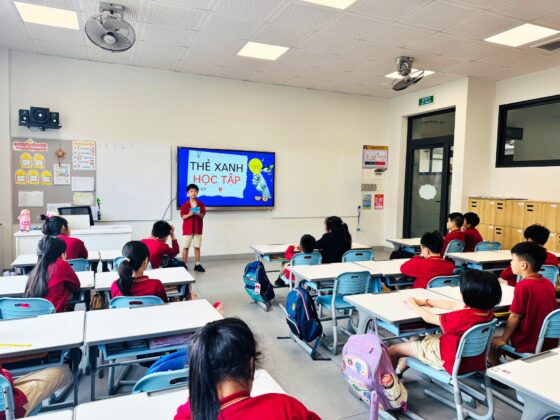
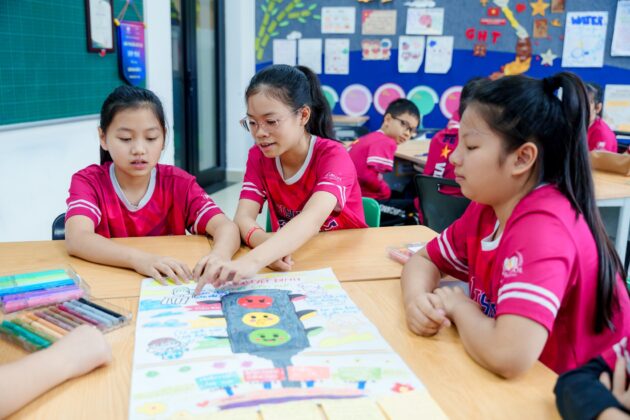
Recognizing that study time is often interrupted by unnecessary interactions, students came up with a simple yet effective way to “protect their focus”: the “Green Light” signal.
When this signal is on, each student enters their own “focus zone,” where everyone respects one another’s learning space.
In class, students use green cards or stickers placed on their desks when they begin working to indicate they are focusing. The whole class follows the “green zone” rule: no interruptions, no chatting. Once they finish, students remove the signal and can resume interaction. This practice is reinforced through shared class guidelines and recognition boards, helping to build disciplined yet approachable study habits.
As a result, students are able to concentrate better, complete their work more efficiently, and develop respect for each other’s learning space. The classroom atmosphere also becomes more relaxed, with fewer interruptions and less stress during study time.
Vinser Vũ Uy shared:
“When applying the ‘Green Light for Learning’ initiative, I feel more confident, and studying becomes lighter and more enjoyable. I can focus better and finish my work faster without distractions.”
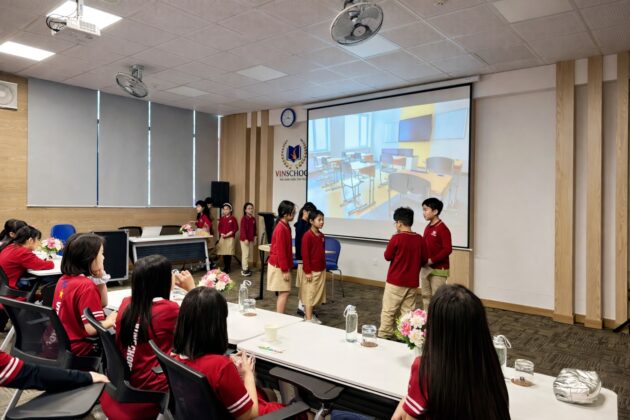
Words can uplift—but they can also leave lasting wounds. With this awareness, students developed the workshop “Words That Lift or Words That Hurt?” to directly address the issue of verbal bullying in the school environment.
Through games, role-playing scenarios, and group discussions, students gradually recognize the impact of their words while exploring more positive ways to communicate. Beyond helping students protect themselves and speak up, the initiative also contributes to building a safe and respectful learning environment.
Vinser Hoàng Minh Trung shared:
“While facilitating the workshop, I realized that words can affect others more deeply than I had thought. Through the activities, we gained a clearer understanding of verbal bullying and positive communication. I feel more confident speaking up to protect myself and support my friends. I hope everyone will communicate with respect so that our classroom can always be a safe and happy place.”
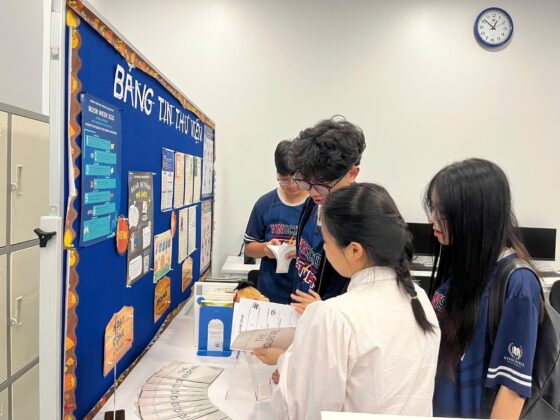
Reading is not only about understanding words, but also about understanding oneself. From this perspective, the “Read Beyond the Lines” initiative was created as a way for students to nurture their cognitive wellbeing through reading.
The initiative features a series of activities—including reading, writing, and reflection challenges—combined with creative workshops and sharing spaces, making reading more engaging and relatable. Over time, students improve their focus, build a deeper connection with themselves, and develop more intentional reading habits.
Vinser Phạm Linh Nhi shared:
“Through the activities, I truly felt that connection—especially when everyone painted on tote bags, with each piece carrying a unique story. I realized that creativity can also be a gentle form of healing, without right or wrong, without the need for advice. And the role of a wellbeing ambassador is not to provide answers, but to create a space where each person can find their own meaning.”
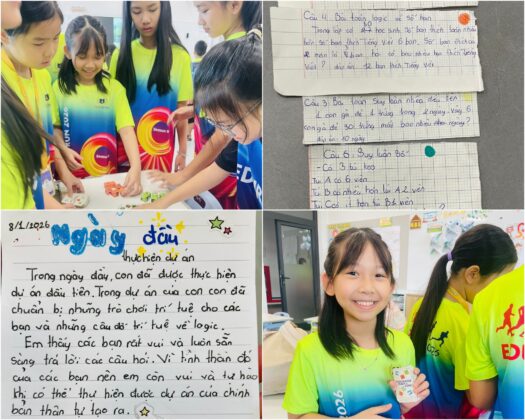
With the hope of making break time more meaningful—enhancing connection and creating positive experiences—Vinsers introduced the “Thinking Corner,” a small space that opens up big opportunities for interaction and cognitive development.
Here, logic games, puzzles, and problem-solving activities are designed for students to participate in, discuss, and collaborate. More than just a relaxing break, the “Thinking Corner” becomes a space where students challenge themselves and learn from one another. As a result, they gradually build patience, strengthen their thinking and problem-solving skills, and foster stronger bonds and joy within the classroom.
Vinser Phan Hoàng Linh Hương shared:
“From the very first day of launching the initiative, I prepared games and puzzles for everyone to join. I felt really happy seeing my classmates excited, always ready to take on challenges and answer questions. It made me proud to be able to bring my own idea to life.”
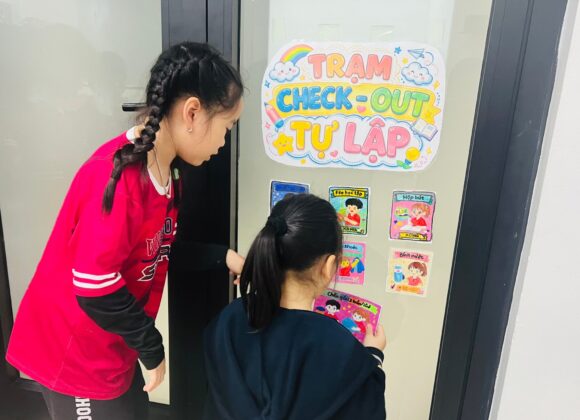
Grade 1 students often forget their belongings and have not yet developed the habit of checking their items before leaving. From this, the idea of an “Independent Check-out Station” was created and placed right at the classroom door—a small but meaningful step to help students build self-discipline every day.
Students decorated their own “Independence Exit Door” and designed simple checklists including books, pencil cases, water bottles, jackets, and more. Before leaving, each student passes through the station to review their belongings, while the duty team helps remind others and celebrates a weekly “Independent Student.”
With this simple yet consistent approach, students gradually become more proactive, significantly reduce forgotten items, and build habits of organization and independence step by step.
Vinser Đoàn Thảo Nhi shared:
“I feel very happy and proud to carry out the ‘Independent Check-out Station’ project. With the support of my classmates and teacher, I’ve become much more confident. Even though the project is simple, it helps us build good habits every day.”
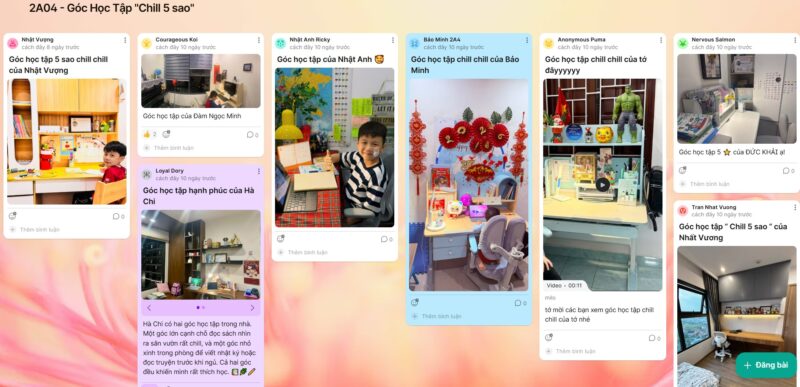
Many students realized that they were easily distracted and often hesitant to start studying. From this, Grade 2 students came up with the idea of breaking study time into short 3-minute intervals to improve focus.
Students design their own study corners using simple tools such as sand timers, “top 3 tasks” boards, and stickers. They study in 3-minute cycles and share their methods with the class.
This initiative helps improve concentration, increase effective study time, boost task completion rates, and build self-discipline habits.
Vinser Hoàng Khánh Tâm shared:
“Even simple tools can help us improve our focus and motivation, making our learning more effective every day. I hope more students will try this idea because it’s very easy to prepare and apply.”
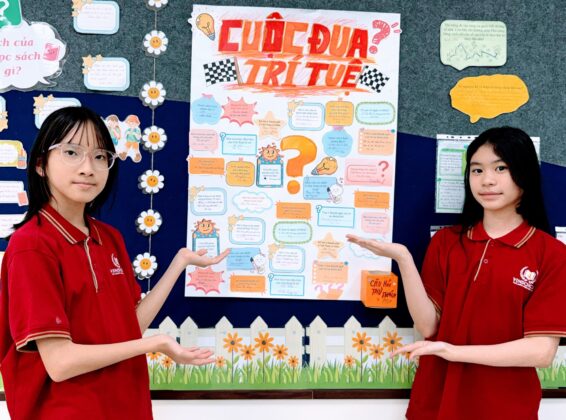
Realizing that they were easily distracted and often hesitant to start studying, Grade 2 students came up with a simple idea: breaking study time into short 3-minute intervals to improve focus.
From this, the “Focused Study Corner” was created using familiar tools such as sand timers, “Top 3 Tasks” boards, and stickers. Students study in short cycles and share their methods with the class to help sustain the habit together.
Thanks to this approach, students gradually improve their concentration, extend their effective study time, and significantly enhance task completion. More importantly, a sense of self-discipline in learning is steadily developed.
Vinser Hoàng Khánh Tâm shared:
“Even simple tools can help us stay focused and feel more motivated to study. Thanks to that, learning becomes more effective every day. I hope more students will try this idea because it’s very easy to prepare.”
![[Wellbeing Initiatives 2025–2026] Emotional Wellbeing – When Students Take The Lead In Creating Positive Emotional Experiences](https://vinschool.edu.vn/wp-content/uploads/2026/03/27/657405113_1410367047785472_1620149146918514212_n-1-500x325.jpg)
![[Wellbeing Initiatives 2025–2026] Live Healthy, Live Positive – When Vinsers Build Habits Through Small Actions](https://vinschool.edu.vn/wp-content/uploads/2026/04/02/662540768_1415545443934299_2694164833126686497_n-500x325.jpg)
![[Wellbeing Initiatives 2025–2026] When Core Academic Lessons Become Spaces For Wellbeing Innovation Practice](https://vinschool.edu.vn/wp-content/uploads/2026/01/26/19.1-500x325.jpg)