Launch of the Innovation Challenge 2025–2026
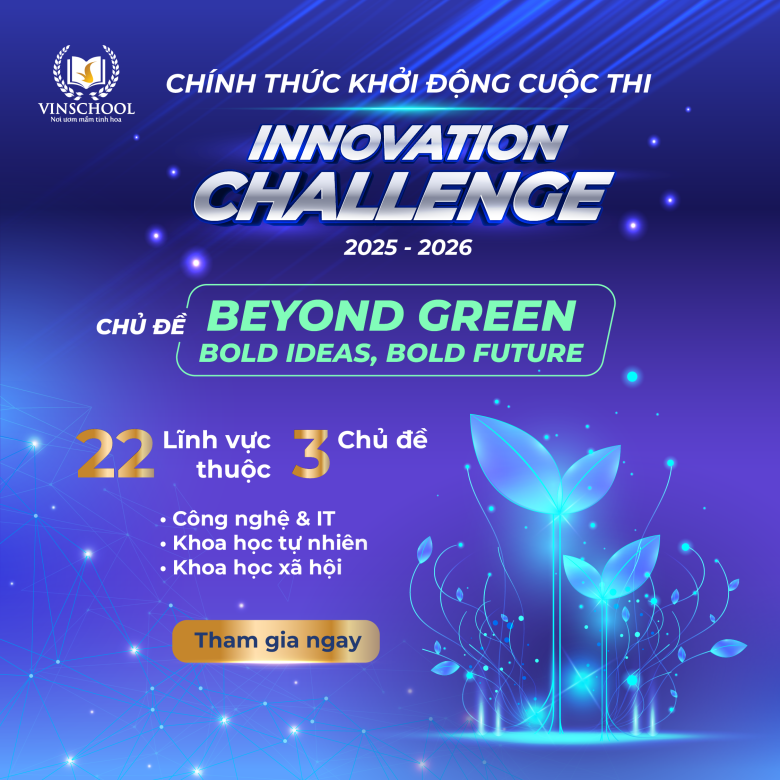
The Innovation Challenge is an annual competition designed to encourage secondary students nationwide to engage in scientific research and innovation across fields such as Natural Sciences, Technology & IT, and Social Sciences.
Under the theme “Beyond Green – Bold Ideas, Bold Future”, the competition aims to inspire students to apply their knowledge to address real-world problems, while providing opportunities to connect and exchange ideas with leading experts. Through this journey, students are guided to develop their research orientation and pursue participation in prestigious national and international science competitions.
Through the competition, the Organizing Committee will identify outstanding research topics and projects to guide and support participation in national Science and Engineering Fairs, as well as renowned international innovation and invention exhibitions.
1. ELIGIBILITY
- Open to all students from Grades 6–12 across the Vinschool system.
- Students may register for the competition through their teachers or campus management board.
- Each project may include up to five students.
2. CATEGORIES
Research projects may fall into one of 22 categories under three main areas: Natural Sciences, Technology & IT, and Social Sciences.
| No. | Category | Subfields |
| 1 | Animal Science | Behavior; Cell biology; Environmental interactions; Genetics; Nutrition and growth; Physiology; Systems and evolution; … |
| 2 | Social and Behavioral Sciences | Development and care; Psychology; Cognitive and social psychology; Sociology; … |
| 3 | Biochemistry | Analytical; Synthetic; Biomedical; Structural biochemistry; … |
| 4 | Biomedical Engineering | Biomaterials; Biological mechanisms; Biomedical devices; Cellular and tissue engineering; Synthetic biology; … |
| 5 | Biomedical and Health Sciences | Diagnosis; Treatment; Drug development and testing; Epidemiology; Nutrition; Physiology and pathology; … |
| 6 | Cellular and Molecular Biology | Cell physiology; Genetics; Immunology; Molecular biology; Neurobiology; … |
| 7 | Chemistry | Analytical; Computational; Environmental; Inorganic; Materials; Organic; Physical chemistry; … |
| 8 | Computational Biology & Bioinformatics | Biomedical modeling; Computational pharmacology; Evolutionary biology; Computational neuroscience; Genetics; … |
| 9 | Earth & Environmental Sciences | Atmosphere; Climate; Ecosystem impacts; Geology; Water resources; … |
| 10 | Embedded Systems | Microcontrollers; Networking and data communication; Optics; Sensors; Signal processing; … |
| 11 | Energy: Chemical | Alternative fuels; Fossil fuels; Fuel cells and batteries; Solar energy materials; … |
| 12 | Energy: Physical | Hydropower; Nuclear; Solar; Thermal; Wind energy; … |
| 13 | Mechanical Engineering | Aerospace; Civil; Computer-aided mechanics; Control theory; Transportation; Manufacturing; Marine systems; … |
| 14 | Environmental Engineering | Biotreatment; Soil management; Pollution control; Waste management and recycling; Water resource management; … |
| 15 | Materials Science | Biomaterials; Ceramics and glass; Composites; Computational materials; Electronic, optical, and magnetic materials; Nanomaterials; Polymers; … |
| 16 | Mathematics | Algebra; Analysis; Discrete mathematics; Game and graph theory; Geometry and topology; Number theory; Probability and statistics; … |
| 17 | Microbiology | Bacteria and antibiotics; Applied and environmental microbiology; Virology; Synthetic antibiotics; … |
| 18 | Physics and Astronomy | Astronomy and cosmology; Atomic and molecular physics; Biophysics; Computational physics; Quantum computing; Theoretical physics; … |
| 19 | Plant Sciences | Agriculture; Environmental interactions; Genetics and reproduction; Growth and development; Plant physiology and pathology; Evolution; … |
| 20 | Robotics and Intelligent Machines | Biomechanics; Control theory; Dynamic robotics; … |
| 21 | Systems Software | Algorithms; Cybersecurity; Databases; Operating systems; Programming languages; … |
| 22 | Translational Medical Science | Diagnosis; Prevention; Treatment; Drug validation; Preclinical research; … |
3. REQUIREMENTS
- Ensure academic integrity throughout the research process – plagiarism, falsification, or presenting others’ work as one’s own is strictly prohibited.
- The research period must not exceed 12 consecutive months, conducted between January of the previous year and 30 days prior to the competition’s opening date.
- For team projects, member changes are not permitted once the project has commenced. All team members must be enrolled at the same campus, and each member’s contribution must be clearly reflected.
- Projects involving pathogens, toxic chemicals, or environmentally hazardous materials are not eligible.
- All projects must be approved, evaluated, and selected by the student’s school in accordance with the official registration and approval process.
- Project displays must comply with the Organizing Committee’s exhibition requirements.
4. BENEFITS
- Students whose projects are selected will receive Certificates and Awards from the Organizing Committee and may be nominated to participate in city, national, and international competitions.
- Projects qualifying for the Final Round will receive financial support.
5. IMPORTANT DATES
- Competition Launch: October 8, 2025
- Preliminary Round: October 8, 2025 – January 17, 2026
- Final Round: Expected in April 2026
The Organizing Committee will continue to nominate outstanding projects for participation in city, national, and international competitions.
We wish all students an inspiring and rewarding experience with the Innovation Challenge 2025–2026!