Congratulations to two talented Vinsers on having their astronomy project selected for launch into space as part of a NASA-affiliated science program
We’re thrilled to announce that the astronomy project developed by Huynh Minh Triet and Nguyen Gia Hy—two Gifted STEM students specializing in Scientific Engineering from the GATE Center—has officially been selected from tens of thousands of global submissions to be launched into space as part of the Cubes in Space 2025 program.
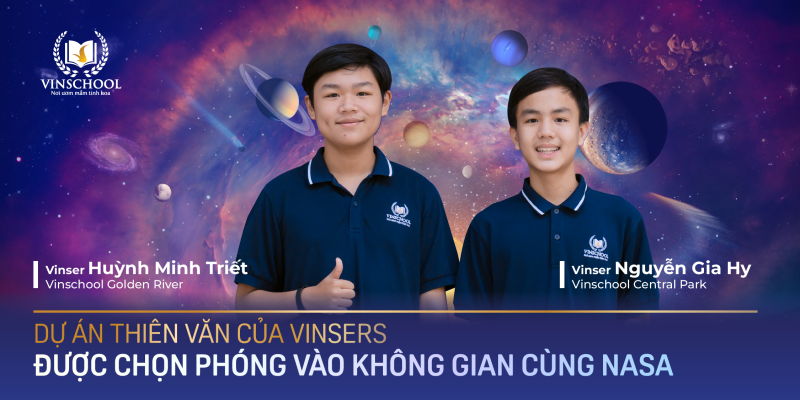
As participants in Cubes in Space—a world-class STEM competition for students aged 11–18—Minh Triet and Gia Hy took on the challenge of designing a miniature cube experiment (measuring just 4x4x4cm) to tackle a real-world problem in space or on Earth. Their bold and innovative direction: “Feasibility Study of a Micro Thermoelectric Generator in Space.” This experiment aims to evaluate the potential of using thermal differences—hot and cold—to generate electric pulses, laying the groundwork for future thermoelectric generators in space and paving the way for renewable energy solutions in extreme space environments.
With expert guidance from the GATE Center, the two Vinsers dedicated the past four months to extensive research, prototyping, and refining their idea. Their hard work culminated in a successful project defense before an international panel of experts. Currently, Minh Triet and Gia Hy are working to fine-tune the experiment based on feedback from the Cubes in Space scientific board, in preparation for its official submission to NASA and upcoming space launch.
Congratulations to both students on this remarkable early achievement in their journey to explore the universe. Follow the Vinschool fanpage to stay updated on the next chapters of their mission to reach for the stars!
——–
Cubes in Space™ is a global STEM education program for students aged 11–18, organized by idoodledu inc. (iEDU) in collaboration with NASA and other partners. The program allows students to design small experiments to be launched into space or near-space environments aboard NASA suborbital flights. Since its inception in 2014, Cubes in Space has engaged more than 25,000 students and 2,700 educators across 76 countries, becoming a premier platform for young aspiring scientists and space explorers.